
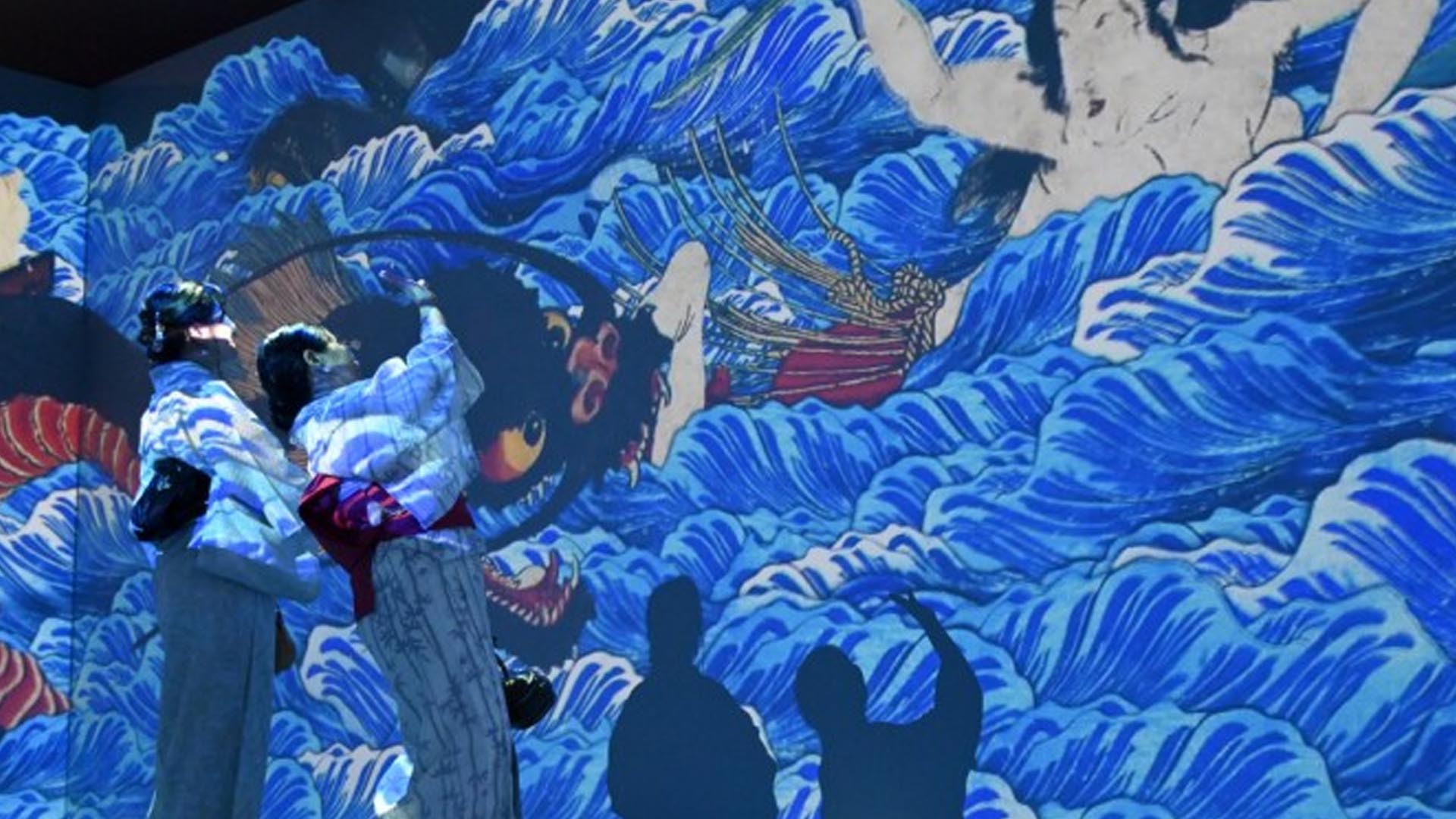






Japanese supernatural creatures known as “yokai” come to life through the power of cutting-edge digital technology in the “Yokai Immersive Experience Exhibition,” which has opened in the central Japanese city of Nagoya.
The exhibition, which began on Saturday at the museum wing of the Kanayama Minami Building and will run through Sept. 23, features an immersive experience in which videos of spooky yokai depicted in artworks, such as the “Hyakki Yagyo Emaki” picture scroll and works inspired by “Hyakumonogatari” supernatural storytelling, are projected in 3D spaces. It also exhibits realistic 3D-modeled figures of yokai.
More than 300 yokai creatures appear in the exhibition, which comprises eight rooms based on distinct themes, such as the yokai birthplace and yokai processions.
The main attraction is a room themed on a wild dance of yokai. Moving images of supernatural creatures fill the room’s walls, ceiling, and floor, accompanied by powerful music for a fully immersive experience.
Explanations of yokai drawings and caricatures from the Edo (1603-1868) and Meiji (1868-1912) eras make the exhibition educational and enjoyable for adults. (PNA)