
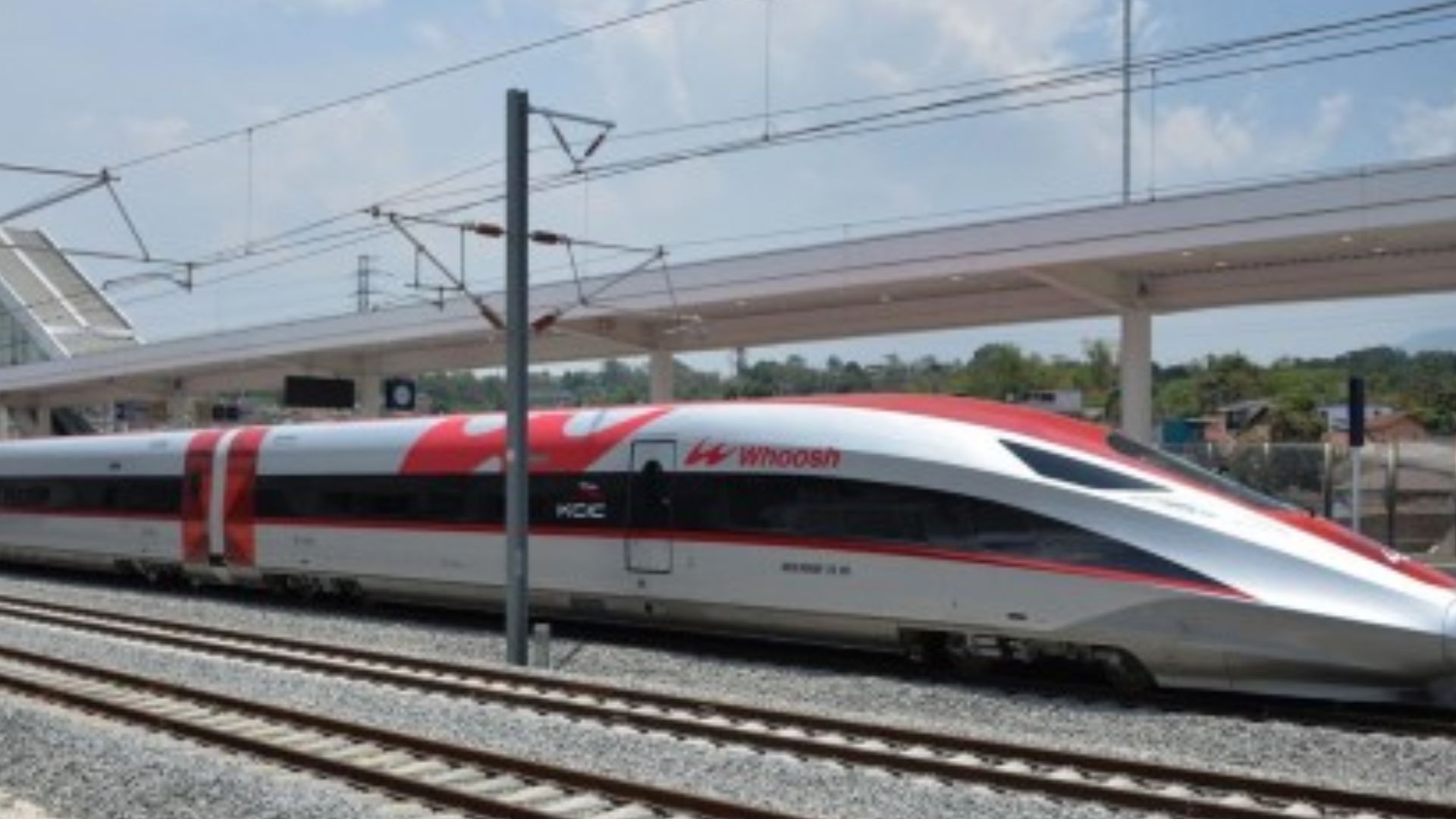






The Indonesian government is grappling with mounting financial strain from its much-touted high-speed railway project led by China.
Roughly two years after the line began operations in October 2023, ballooning construction costs and weaker-than-expected passenger demand have made debt repayment increasingly onerous. As a result, the government has been forced to inject public funds into the project-, an option that was not part of the original plan.
According to local media, Indonesian Minister of State Secretary Prasetyo Hadi revealed on Feb. 10 that the government has decided to use the national budget to help repay the railway project’s debt. Annual expenditures related to the support are expected to reach about 1.2 trillion rupiah, or roughly 11 billion yen.
The high-speed railway, branded as Whoosh, operates at speeds of up to 350 kph, covering the 140-km. route between Jakarta and Bandung in West Java province in about 45 minutes. Yet daily ridership remains at less than one-third of the original forecast of 60,000 passengers, largely because fares are higher than those of conventional trains and several stations are located far from city centers.
During President Susilo Bambang Yudhoyono’s tenure (2004-2014), Japan’s Shinkansen bullet train system was considered the leading candidate for Indonesia’s high-speed rail project. However, in 2015, under his successor President Joko Widodo, China secured the contract after asserting that the project would not require any funding from the Indonesian government.
The launch of train services, initially planned for 2019, was delayed by four years, and the project’s total cost swelled to USD7.2 billion, about 20 percent more than originally estimated. With 75 percent of the financing provided by the China Development Bank, interest payments have become a significant burden on the project’s operator.
The high-speed railway in Indonesia was once a showcase project of China’s vast Belt and Road infrastructure initiative. Marking the second anniversary of the line’s opening last October, Chinese Foreign Ministry spokesperson Guo Jiakun claimed that the project had been highly regarded in Indonesia. “We should look not only at financial data and economic indicators, but also at public benefits and overall returns,” he said.
A future extension of the high-speed railway to eastern Java is under consideration, raising hopes that, if implemented, the project could become more profitable. Still, after China’s original premise – that the railway would require no government funding – collapsed, some within the Indonesian government have begun to argue that the proposed extension does not necessarily need to be undertaken by China, according to sources. (Jiji Press)